
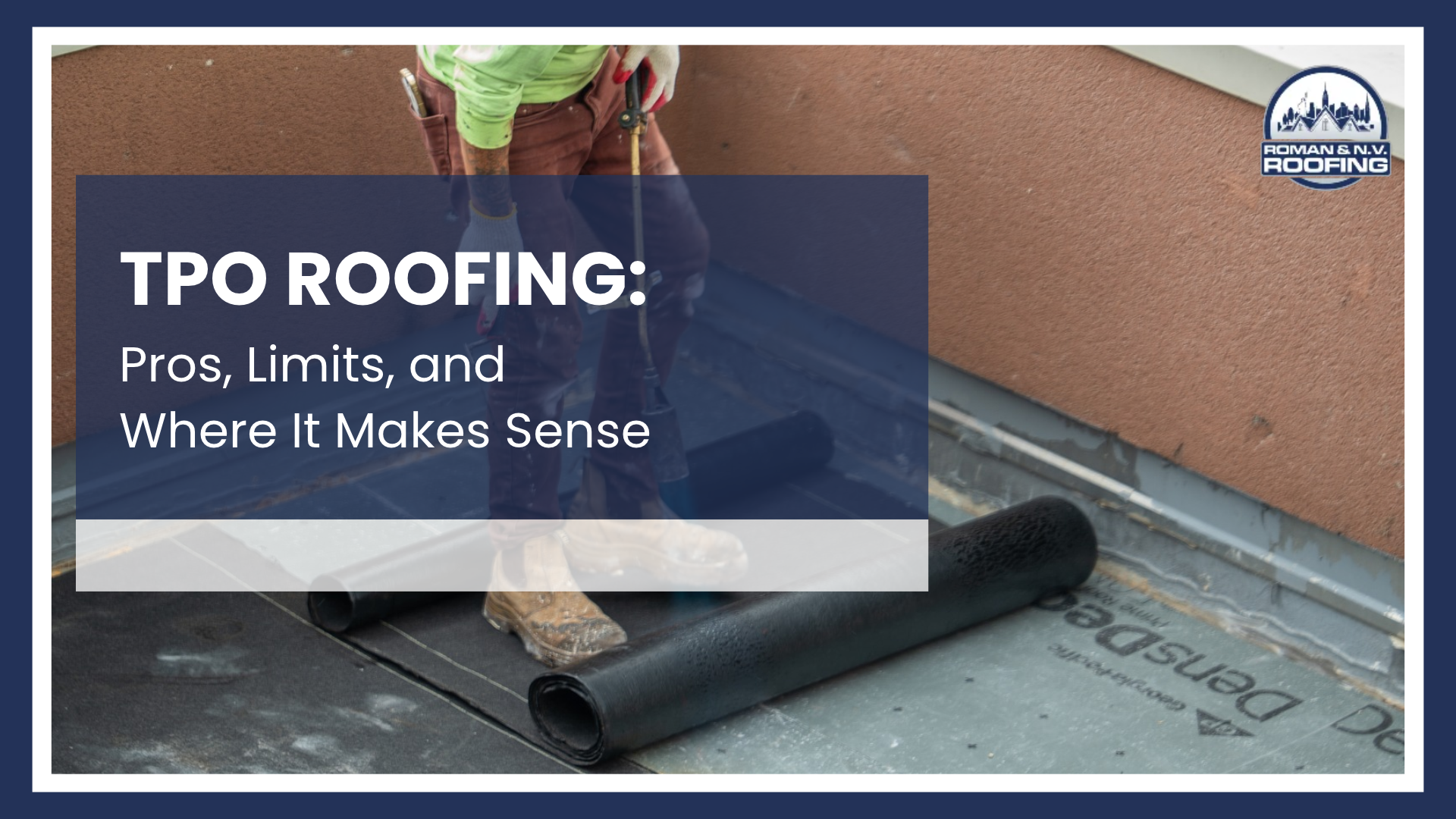
TPO roofing is a white, heat-welded single-ply membrane that works best on large, sunny commercial roofs where cooling costs matter. Its biggest strengths are a reflective surface and seams that fuse into one solid sheet. Its main limits are puncture risk, aging that makes later repairs harder, and a heavy dependence on installer skill.
If you are weighing a new roof for a warehouse, store, or office building in Brooklyn, TPO will almost certainly come up. This post explains what you gain, what you give up, and the kinds of buildings where it earns its place.
TPO Roofing in Plain English
TPO stands for thermoplastic polyolefin. Thermoplastic simply means the material softens when heated and hardens again as it cools. That property is what lets installers fuse two sheets together with hot air instead of glue or tape.
The membrane comes in rolls, usually white, though tan and gray versions exist. Common thicknesses run from 45 to 80 mils, and the thicker sheets offer more protection against punctures and weather. TPO has been on American roofs since the 1990s, and manufacturers have improved their formulas a great deal since those early years.
Why So Many Brooklyn Warehouses Use TPO Roofing
Walk the rooftops around Bushwick, East New York, or Sunset Park, and you will see a lot of bright white roofs. Building owners pick TPO for a few practical reasons.
First, the white surface bounces sunlight away instead of soaking it up. On a big one-story warehouse, the roof is most of the building’s exposure to the sun, so a reflective surface can make the space below noticeably cooler.
Second, welded seams are hard to beat. Once the edges fuse, nothing at the joint can loosen or wash out with time.
Third, TPO is light and quick to install on large, open roofs. That keeps disruption shorter for businesses operating underneath.
The Limits of TPO Roofing
Every roofing material has trade-offs. Knowing them before you sign a contract helps you plan for them instead of being surprised later.
Punctures. TPO is tough, but a dropped tool or a sharp boot heel can still cut it. Roofs with lots of service traffic need walkway pads and careful crews.
Aging and weldability. As TPO weathers, its surface gets dirty and oxidized. Older membrane can be harder to weld, so repairs on an aging roof take more cleaning and preparation to bond properly.
Installer skill. The welds are only as good as the person running the welder. Temperature, speed, and a clean surface all affect the bond, and a bad weld may not show itself until months later.
Grease exposure. TPO resists some chemicals better than rubber, but it still is not the top choice near heavy kitchen exhaust. PVC usually handles grease better on restaurant roofs.
Cold-weather installs. Crews can weld in winter, but low temperatures shrink the margin for error. Good contractors adjust settings and test seams more often when it is cold.
Inside a TPO Seam Weld
Most of a TPO roof’s reliability lives in its seams, so this step deserves a closer look. Installers overlap two sheets and run a hot-air welder along the edge, either a walk-behind machine for long straight runs or a handgun for corners and details.
After the weld cools, a careful crew drags a seam probe along every inch to find gaps. This simple tool catches soft spots that the eye easily misses. Some also cut small test samples at the start of each day to confirm the welder settings. Ask your contractor whether they do both, because those habits separate solid TPO jobs from leaky ones.
Fastened, Glued, or Induction Welded
The attachment method affects wind resistance, install speed, and future repairs. Here are the main choices:
Mechanically fastened: screws and plates secure the sheet at the seams, which is common and fast
Fully adhered: the sheet gets glued in place for a smooth surface that stays quiet in wind
Induction welded: special plates under the membrane get heated and bonded from above, so no screws pierce the top sheet
On older Brooklyn buildings, the deck type often decides the method. A contractor should check whether the deck will hold fasteners before choosing a system.
Where TPO Roofing Makes Sense, and Where It Doesn’t
Some buildings are a natural match for this material. TPO tends to shine on:
Large warehouses and distribution buildings with full sun
Retail and office buildings with big air conditioning loads
Roofs that need a fast install with limited disruption
Other roofs call for something different. Kitchens that vent grease onto the roof usually do better with PVC, busy row house roofs often suit modified bitumen, and big low-traffic roofs on a tight schedule can work well with EPDM. For a side-by-side view of each option, see our guide to Brooklyn flat roof systems.
Fixing a TPO Roof
Small TPO repairs usually involve cleaning the area, preparing the surface, and heat-welding a new patch over the damage. For loose or open seams, crews scrub the old edges clean and weld them again.
On older roofs, a patch may not weld well even after cleaning. In that case, roofers switch to compatible primers and tape made for TPO. When cracks spread across the whole surface or the insulation below turns wet, replacing the roof is usually the smarter move.
Questions to Ask Before You Choose TPO
A short conversation with your contractor can save years of headaches. Bring these questions to your estimate:
What membrane thickness are you recommending, and why?
Will the roof be fastened, adhered, or induction welded?
How do you test seams during and after the install?
How will you protect the roof around HVAC units?
What warranty covers the materials and the workmanship?
Making the Call on TPO Roofing
TPO roofing earns its popularity on wide, sunny Brooklyn roofs where a cooler building and a quick install pay off. In return, it needs a skilled welding crew, protection from heavy traffic, and a repair plan for later in its life.
Our family-owned company has installed and repaired flat roofs across Brooklyn since 1987. Curious whether TPO suits your building? Give N.V. & Roman Commercial Roofing a call at (917) 440-1800, and we will take a look at your roof.
FAQ Section
Q: What is TPO roofing made of?
A: TPO is a thermoplastic polyolefin membrane, a single-ply sheet that softens with heat so installers can weld seams.
Q: Is TPO better than EPDM for a warehouse?
A: On sunny warehouse roofs, TPO’s white surface and welded seams often give it an edge over black rubber.
Q: Can an old TPO roof be repaired?
A: Often, yes. An aged membrane needs extra cleaning before welding, and some repairs use TPO-compatible tape instead.
Q: Why do TPO seams fail?
A: Most seam failures trace back to poor welding, such as low heat, dirty surfaces, or rushed work.
About the Author
Billy Duka is a second-generation roofer with N.V. & Roman Commercial Roofing, the family-owned Brooklyn company that has worked on local roofs since 1987. He writes practical guides that help building owners compare roofing options and plan repairs.
