
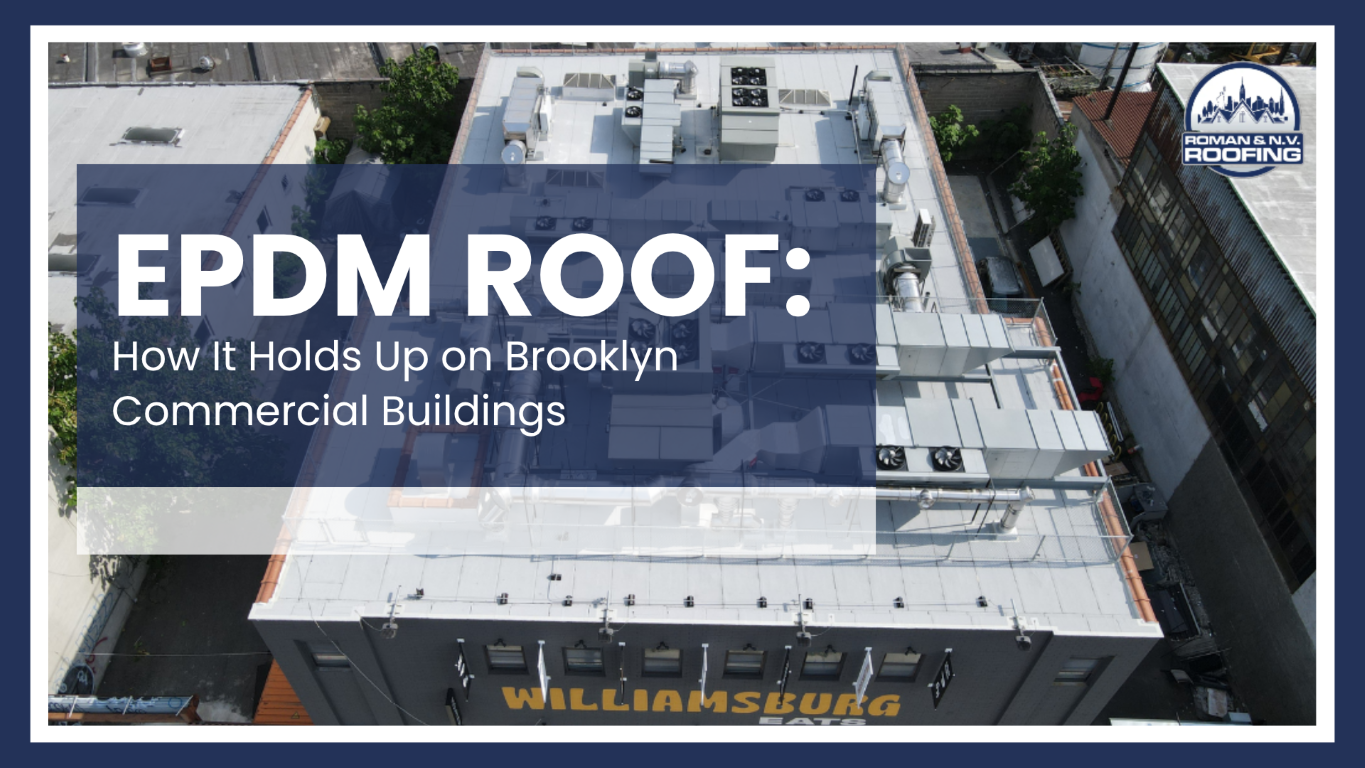
An EPDM roof holds up well on most Brooklyn commercial buildings, especially large, simple roofs with little foot traffic. The rubber membrane shrugs off cold winters and strong sun, and its wide sheets keep seams to a minimum. Most problems we find come from aging seams, shrinkage at the walls, or punctures from rooftop work.
If you own a warehouse in Sunset Park, a mixed-use building on Flatbush Avenue, or a garage in Greenpoint, there is a good chance EPDM is over your head right now. Here is what that means for your building, in plain terms.
What Is an EPDM Roof?
EPDM stands for ethylene propylene diene monomer, which is a mouthful, so most roofers just call it rubber roofing. It arrives on the job in big rolls, and installers spread it across the roof in sheets that can cover a large area in one piece.
You can buy it in different thicknesses, measured in mils. Thicker sheets resist punctures better and usually last longer. Black is the standard color, although white versions exist for owners who want a cooler surface.
The material has been used on low-slope roofs for decades. That long track record is one reason so many Brooklyn property managers still choose it today.
How Crews Install EPDM on Brooklyn Buildings
There are three main ways to attach an EPDM roof. The right one depends on your building’s deck, height, and wind exposure:
Fully adhered: bonding adhesive locks the sheet to the insulation or cover board below
Mechanically attached: fasteners and plates hold the sheet along its edges
Ballasted: loose stone or pavers weigh the membrane down
Fully adhered systems are the most common choice on older Brooklyn buildings. They lie flat, resist wind uplift, and make leaks easier to trace. Mechanically attached systems go down faster, but the sheet can flutter in strong winds if the fastening pattern is weak.
Ballast works on some large, newer roofs. However, plenty of century-old decks in Brooklyn were never built to carry that much extra weight, so a structural check comes first.
Where an EPDM Roof Performs Best
Rubber stays flexible when temperatures drop, which matters in a city with long, icy winters. A brittle membrane can crack during freeze and thaw cycles, while EPDM bends and recovers.
Wide sheets also mean fewer seams on big roofs. On a warehouse or a broad commercial roof with only a few vents and units, that is a real advantage. Fewer joints mean fewer places for water to sneak in.
EPDM is also friendly to repairs. Patches bond well when crews clean and prime the surface correctly, so small problems rarely require tearing anything out.
Weak Spots to Watch on an EPDM Roof
No roof is perfect, and EPDM has a few habits worth knowing. Here is where we see trouble most often.
Seams. Older EPDM roofs often used liquid adhesive at the seams, and that glue dries out over the years. Newer roofs use seam tape with primer, which holds up better but still needs checking. When an edge lifts, water slips under the sheet and travels before it shows up inside.
Shrinkage. As rubber ages, it can shrink slightly. Over time, that pull can lift the membrane away from parapet walls and curbs, leaving the flashing stretched across a gap. Roofers call this bridging, and it is a common cause of leaks along the edges.
Punctures. HVAC techs, cable installers, and dropped tools can all tear a rubber membrane. Walkway pads around rooftop equipment cut down on this damage.
Grease and oil. Petroleum products break down EPDM. Restaurants with kitchen exhaust fans on the roof often see soft, swollen rubber around those vents.
Heat. Black rubber soaks up summer sun, which warms the floor below. A white membrane or a compatible reflective coating can help with that.
Repairing an EPDM Roof: What Usually Works
Most EPDM repairs are straightforward when the rest of the roof is sound. Crews scrub the area, apply primer, and bond a rubber patch or cover tape over the damage. Lifted seams get the same treatment, with fresh tape over the old joint.
Bridged flashing takes a little more work. Roofers release the tension, add new flashing that fits the corner properly, and secure the edge again. Areas with grease damage usually need the soft rubber cut out and replaced.
Repairs stop making sense when seams fail all over the roof, the insulation underneath is soaked, or the membrane has shrunk away from most walls. At that point, a new roof is usually the better use of your money.
Caring for an EPDM Roof Through the Seasons
A little seasonal attention goes a long way with rubber roofing. In the fall, clear leaves and debris from drains and scuppers so water can leave the roof. Winter brings snow, and shovels or ice picks can slice right through the membrane, so leave heavy snow removal to a professional crew.
Spring is the best time to walk the seams and wall flashing for anything that lifted over the winter. In summer, take a close look around air conditioning units and exhaust fans, since that is where service crews walk and drop tools. Keeping a few photos from each visit makes it easy to spot changes from year to year.
Is EPDM the Right Fit for Your Building?
Every building is different, so material choice should follow the roof’s real conditions. EPDM tends to be a strong match for:
Large, simple roofs with few penetrations
Buildings where few people walk on the roof
Owners who want proven, easy-to-repair material
It may not be the best choice for restaurants with grease exhaust, roofs with heavy daily foot traffic, or buildings where a bright, reflective surface is a top priority. In those cases, TPO, PVC, or modified bitumen may fit better. Our guide to flat roof systems in Brooklyn compares those options side by side.
Getting the Most From Your EPDM Roof
An EPDM roof can protect a Brooklyn commercial building for a long time when someone keeps an eye on the seams, the wall flashing, and the areas around rooftop equipment. Check those spots twice a year and after major storms, and fix small issues before water reaches the insulation.
Our family-owned team has worked on Brooklyn roofs since 1987, and we handle EPDM inspections, repairs, and replacements across the borough. If your rubber roof is showing its age, call N.V. & Roman Commercial Roofing at (917) 440-1800 to schedule an inspection.
FAQ Section
Q: How long does an EPDM roof last in Brooklyn?
A: With good installation and regular checks, many EPDM roofs last 20 years or more on Brooklyn commercial buildings.
Q: Can an EPDM roof be repaired instead of replaced?
A: Yes. Small tears, lifted seams, and worn flashing can usually be patched when the insulation underneath stays dry.
Q: Why is my EPDM roof pulling away from the walls?
A: Aging rubber can shrink over time, pulling the membrane and flashing away from parapets and curbs.
Q: Is EPDM good for restaurant roofs?
A: It is not ideal. Grease and oil from kitchen exhaust can soften EPDM, so PVC is often a better choice.
About the Author
Billy Duka is a second-generation roofer at N.V. & Roman Commercial Roofing, a family-owned Brooklyn company working on roofs since 1987. He writes to help property owners understand their roofs and make clear decisions about repairs and replacements.
